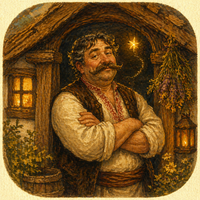
Night tale 14 parts
A Stranger's Shadow
Translated from the Ukrainian original. Read the original in Ukrainian
Not every shadow follows its own master. On St Elijah's Day, when the cattle are already driven home early, an old herdsman saw the cow of a woman named Yavdokha. The cow - dappled, placid, with a full belly. But the shadow trailing behind her was somebody else's: long-legged, humpbacked, with a sharp nose. And it walked not beneath her but behind, as if it had only just crawled into that body and had not yet learned how to graze.
Sit closer to the coals. There are nights when it's better not to keep the door at your back, and not to look at your own shadow too long - a shadow is not just a stain of light, it is an anchor by which the soul holds on to the earth. And woe to the one whose shadow somebody has decided to swap while its owner sleeps.
This happened in a village near Myrhorod, where the yards stood far apart and the gardens ran up against the ravine. In summer the cows gave so much milk the housewives could barely carry the pails. But one widow, Yavdokha, had a dappled cow that began to give strangely little. She wasn't sick, she ate well, her eyes were clear, but the milk barely covered the bottom of the pail.
Yavdokha blamed the evil eye: she sprinkled the threshold with holy water, poured salt under the manger, smoked the cowshed with wormwood - and none of it helped. Then one day toward evening the herdsman was walking with the herd across the common. The sun was setting low, shadows stretched all the way across the road. And he saw: the dappled cow was walking, but the shadow she cast was not a cow's.
The shadow had long thin legs, a sharp nose, and walked a little behind, as if it couldn't keep up with the animal. And the cow gave off a smell of sour milk, singed hair and rotting leaves. The herdsman thought the evening haze was playing tricks on his eyes. But the next day at noon, when shadows are shortest, he looked at the dappled cow again. The shadow lay on the grass, but it had no udder.
Instead, the shadow of a woman's skirt and a sharp nose showed plainly on the ground. People laughed at his story. They said the sun had struck the old man in the eyes, and an evening shadow will show you worse than that when the day is long and a man has been on his feet since dawn. But the laughter died when Yavdokha found a small wooden milking stool by the cowshed. It was not hers.
Underneath, on the legs, someone had carved three crossed lines and rubbed stove soot into the wood. And in the evening the jug of milk standing on the earthen bench by the wall fell over. The milk spilled, but it didn't run in a stream. It lay where it fell, like thick cloudy glass. The old women whispered of a swapped shadow. They said there are witches who don't steal milk from the udder. They steal the very essence.
They leave their own shadow with the beast and take the cow's for themselves. And while the stranger's shadow walks the pasture, the witch milks not the cow but its strength. And the animal stands, eats, chews, but inside it is already hollow, like an old willow. Yavdokha called in the wise woman. She came with a bunch of St John's wort and a live coal in a potsherd.
Three times she walked around the cow, scattering ash by its hooves, but the coal suddenly turned black and went out, though there was no wind in the shed. The wise woman went pale. "The animal can't be saved anymore," she said. "But the trouble isn't only in her. Look at yourself, poor soul." Yavdokha turned toward the wall of the cowshed, where the evening sun was falling.
A shadow fell from Yavdokha. But it was not the shadow of a young woman. It was the shadow of an old humpbacked crone leaning on a knotted stick. And that stranger's shadow was slowly reaching a hand toward Yavdokha's throat. The woman felt her breath catch - the shadow was squeezing her neck. The wise woman didn't wait. She snatched the sickle that hung by the door, stepped up to the wall and drew the blade right where the old shadow's neck was.
From under the ground came not a scream but a long hoarse exhalation. There was a smell of singed hair and sour milk. And the cow's shadow, udder and all, slowly returned to its place. The dappled cow collapsed that same evening and never got up again. They buried her, sprinkled with salt. The witch was never found in the village. Only one old woman from the edge of the hamlet didn't come out of her house the next day.
She said her neck hurt, though nobody had seen any wound. And for three days her chimney gave off the smell of singed hair. Since then a custom has remained in that village. They tried to milk the cow before sunset. Not because milk is worse at night, but because toward evening shadows grow longer and begin to creep where nobody invited them.
And if milking late couldn't be helped, the mistress of the house put a handful of salt under the stool and set the pail so that not a single shadow fell on the milk. Because the old folk said: a shadow that has touched milk can show a stranger the way to the udder. And if, on the way back from the cowshed, your shadow suddenly lagged behind your feet, you didn't cry out and didn't cross yourself.
You only threw salt behind your back. Without looking round. Because look round - and you show that you recognized it. And then it will already know whose place to try on.
Your verdict
Did you like this night tale?
Be the first to rate this story.
If the story touched you, the inn will be grateful.