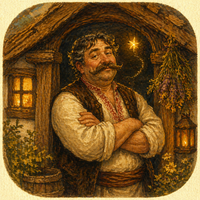
How many people does it take to ruin a couple's wedding night? In Vyshenka, seven and Baba Paraska were enough - and the poor shift nearly never came off at all.
Two kums, one barrel, and half the village with pots on the eve of Spas. When Ovsii and Radko can't agree whose honey is whose, the bees settle it themselves - wing to wing.
Panas eats a handful of strange mushrooms out of someone else's bowl, and by evening half the village has him tied to a bench while the priest demands to know who is sitting inside him. And it all began with "don't touch the mushrooms."
A young couple finally reach their own house after the wedding, hang a rushnyk on the latch - and the whole village takes it as an invitation. The bride, it turns out, gives as good as she gets.
A sexton set out to read an announcement so solemnly that even the flies would sit up straight. But a rooster decided the village was short one authority - and crowed his own version.
Panas swore his rooster Hromylo was a warrior who'd beaten seven and scared off a wolf. The innkeeper's careless tongue turned it into a tournament - and then a little grey hen named Motria stepped into the ring.
Karpo bought the laziest pig at the fair for half price and declared her a prophetess. Every fate she foretold smelled suspiciously of salo - until Okhrim the blacksmith came with a red-hot copper coin.
Did Panas thought he had a talent for hiding his vyshnivka. But his house had one more resident - a khatnyk who took no bribes, not even kasha with butter, and demanded only one thing: justice.
Has a woman ever grabbed you by the pecker just when you thought nobody was watching? Mykyta was nineteen, Baba Palashka was hunting a polecat, and by noon the whole village of Vyshenka knew a story that never happened - and one that very nearly did.
The signal cuts through the headphones, the enemy is too close behind, and between two heartbeats the cockpit smells of dust from the old yard - where Mama once held the bicycle seat and told little Ostap not to look back.
The widow Yavdokha needed a man's hand about the house. Hrytsko brought a hammer. It took a jug, a bed, and the patience of half the village before justice was finally done.
Hrynko and Olenka's first night together in the old barn: fingers that won't obey, laughter in all the wrong places, an elbow that makes the whole barn boom, and a straw that says more than any big words.
Trokhym loved Marfa for twenty years without the proper science - until an old miller at the fair told him a real man reads his lady poetry. Paper, ink, plums in uzvar, and a stolen flower did the rest.
Little Tymko puts a makitra on his head, takes up a wooden sword and goes off to slay a dragon - only the dragon turns out to be Butsko the goat, and glory ends up at the bottom of a rain barrel.
Baba Paraska decided to hold her own funeral while still alive - to check the quality herself. But Hrytsko lay down on the bench first, and in Vyshenka they now sing over you before deciding whether you're dead.
He fell in battle, and she stood over the cliff, asking the wind whether an angel would catch her. But true love does not call the living into the grave - it pushes them back into life with all its strength.
Mykyta drove a wedge into an old fence plank, a knot popped out - and through the round little eye he saw Palazhka in her washtub. Looking was free. Touching had a price. And the peg, it turned out, was shorter than he'd claimed - but diligent.
Myron asked his kum Okhrim to prepare the Suitor for a matchmaking at noon. One small problem: Okhrim didn't know the Suitor was a boar. A tale of icy well water, oat gruel and a pumpkin split in two on Ivan's counter.
Trokhym hears from a passing merchant that the gentry always keep a third someone in the bedroom - and decides he wants the same. Marfa promises him the most watchful third there is. Enter Hnat the goose.
Old Yukhym the carpenter squinted his left eye, declared the sky heavier on the left, and by noon all of Vyshenka was hauling hogs and bracing my inn with their shoulders - anything to keep from rolling into the ravine.
Deacon Pylyp brought the thickest candle to the fair and praised it so shamelessly the women blushed to their heels. Then the widow Motria pushed through the crowd and said the two words no braggart survives: then light it.
Baba Toma hires two boy scouts to track down why Did Tolia comes home cheerful and reeking of garlic. Nettles, a furious goose, a traitorous dog - and a secret that smells nothing like the boys expected.
On Kupala night cocky Stepan set out to catch a whole handful of girls' wreaths - until the river brought him one too heavy for his pride, and Baba Hapka stepped out from behind the bonfire.
At the autumn fair in Kamianka there was one cart the men approached with a rooster's swagger and left red-faced and silent. No witchcraft - only Maryna, her sharp tongue, and a queue of men who walked onto the skewer all by themselves.
Khoma and Hrytsko decide to become true Cossack scouts and mount a secret raid on the cucumber beds. The fortress stands firm, the hens still haven't recovered, and the trophy turns out somewhat smaller than planned.
Ilko the carpenter could talk to trees but went mute before Olena. So one night he whispered his love through a hole in a wattle fence - only the fence, and the ears behind it, belonged to somebody else entirely.
Stepan wasn't lazy - he just believed a gate should shut itself. Three inventions, one goat and a scribe covered in mud later, Odarka reminded him what the most reliable mechanism on a farm really is.
Mykyta wanted a calf so badly he arranged a date for his cow Kvitka - with apples, a rushnyk, a fiddler and a nervous man in charge. But love, even cow love, doesn't like being stood over with a plan.
A Galician raftsman left the innkeeper a plain river stone - one that smells not of silt but of hay and warm bread. A tale of a village where the river roared people hoarse, and an old willow weaver who taught them to hear again.
річковий каміньтиша і шумплотогінсільська мудрість
Baba Palazhka gives Tymko and Motria the plainest of talks before their wedding night - and the two of them end up fearing her explanations more than sin itself. Add one cat with claws, and the night takes its own course.
баба Палажкаперша шлюбна нічТимко і Мотрясільська мудрість
On the highest shelf of Yakym the shoemaker's workshop stands a pair of little shoes with embroidered poppies - made for a road they never saw. And every spring he waxes their soles anyway.
A mirror doesn't lie, they say. Don't believe it. In Vyshenka lived Marichka, who searched an old clouded glass every morning for a reason not to go out to people - and Levko, who saw her without fear, with love.
An old bell-founder stops at Ivan's Inn and shows a small copper bell that never rings from wind or a stranger's hand - it answers only when someone begins to forget a beloved voice.
мідний дзвоникпам'ять про коханогостарий ливарникголос в тиші
Ostap hears from an old fortune-teller that a sign of fate will appear on his palm - so he stops working altogether. But fate, it turns out, prefers hands with flour on them and at least one rescued varenyk.
Tymko loved Hanna since childhood and spoke to her in signs - water carried, firewood chopped, a pear on the windowsill. But signs without words are a pie under a towel, and one day Ostap simply said it out loud.
On the shelf behind Ivan's counter stands a wax-sealed jar with a handful of black earth inside. The whole village laughed at the man who filled it - but he was catching thunder for the one he loved.
Baba Marfa from Yablunka believed borshch was magic, and stirring it with the wrong spoon meant not dinner but an insult with beetroot in it. While she put her spoons on trial, the guests grew hungrier - and hungrier is only one step from angrier.
Widow Orysia's roof leaked so badly you could do the washing indoors, but her pride was sturdier than any rafter. So her neighbor Mykola brought his honeycombs to her gate - and a cunning lesson in helping those who refuse all help.
A good stove-maker, they say, is no mason but a doctor for the house. After her blacksmith husband died, old Uliana froze even in her sheepskin - until master Bohdan came and built her an ugly hump of clay.
How do you tell a kind man from a merely good one? A kind one quarrels with a millstone so as not to shame you. An inn story about old Taras the miller, his "clumsy" stone, and half-sacks of the whitest flour.
Headman Ruslan does everything "for the people" - a road, a well, a bridge - and it all somehow ends up by his own cellar. Until the village quietly teaches the water to come home.
How do you get an unsplittable oak log split when your only helper is the laziest lad in the district? Old cooper Semen knows: not with an axe, but with a plate of honey cakes and a well-placed insult.
Did Mykyta decided to prove his old powder flask could still shoot - with the help of fierce horseradish and mustard. Two minutes later the whole village nearly came running to the black smoke over his abandoned smithy.
A merchant buys a hundred singing clay cuckoos by the weight of dry clay alone - and in town they only wheeze like frogs. The old potter has a quiet lesson ready: a bird sings when you share your breath, not when you pinch your kopeck.
Hryts swore to his wife that not a drop would touch his lips at the fair. His kum Lavrin nobly offered to drink for him. The scheme was perfect - until the cherries from the nalyvka had their own opinion about promises.
Ostap couldn't hold a brush straight, but with words he could walk a pig into heaven. Then Motria's goat died, and the whole village found out what his crooked pictures were really for.
Every spring the sexton Ostap carried a blue ribbon up the bell tower, and the village whispered of witches and storks. But the truth was quieter than any bell - and louder than all of them.
A grandson comes back from the city with books under his arm and an axe in mind for the old willow by the hives. Did Yakiv doesn't argue - he just mentions a village custom, and lets the tree do the rest.
The village decides it's time to marry off shy Luka and drags him to the fair, where the women inspect him like a sack of choice grain. Salvation smells of herring, sour apples and truth.
A traveling carpenter is locked for the night in a dead man's house, where something with icy fingers breathes at the back of his neck and counts along with him. And whatever you do, don't lose the count.
A traveling potter from Polissia leaves a warm clay jug on Ivan's table - not simple crockery, but a vessel for unspoken words, shaped by a deaf master who sees the weight of what people cannot say aloud.
Levko's conscience rang like a whole church bell tower, and his prayers stretched to the third try each night. Until his wife Yaryna decided that even sin can be outwitted - gently, cunningly, and for the sake of a good night's sleep.
An old flax trader tells of a mountain weaver who takes no new cloth and nothing from the happy - only shirts cried in and dresses worn in waiting. A quiet inn tale about why thread that has known cold is the only thread that warms.
A healer's sore throat, half a jug of holy Galician sour cream, and one old man who refuses to sell a kerchief without a proper haggle. At the fair, the most precious thing is not the goods - it's time.
Liubomyr came to Kateryna with poems, the moon and polished boots - and returned a great defender of nightingale honour. The village had its theories, from the evil eye to too much kvas, but the truth hid in the small things.
Ivan the innkeeper, big as an oak, wipes two foolish tears at the counter - not from grief, but from the smell of grass, which carries him back to a snail, a boy, and everyone who once loved him without conditions.
Odarka lay dying, waiting for the first snow that would not come. So her husband Lukash locked himself in the storeroom with a linden log and a carving knife - and decided to make winter himself.
When a man's main plough refuses to plough, he blames the firewood, the moon and the cat. So Hnat slipped in to see Vira the healer - and got an ointment, a rooster and a cure he never expected.
Old Matviy quits drinking and takes up evening prayers - only his coat smells not of incense but of pickled plums. Zhadana follows the tracks to the old bell tower, where salvation turns out to come with a jug of slyvianka.
Tymish swore he could read a woman's thoughts before she finished thinking them herself. Then he leaned on the quiet weaver Solomiia's fence - and met her woodpile, her goat and her pumpkins.
Old Okhrim hears that the widow Motria wants a husband who's simply alive - and decides he's just the man. Soot on his mustache, his father's red sash round his belly, and off he goes courting. The stump by the well, though, has its own opinion.
A man dearly loved his midnight salo, but the stairs in his house creaked like old bones. He waged a quiet war on them - with oil, with felt boots - until the sour cream itself had the final word.
A man greases his creaky cart wheels in the dead of night so as not to ask anyone for tar. By morning the whole street's animals are trailing behind him like a holiday procession.
A love-struck lad hears that his sweetheart likes decisive men, so he crawls under her window at night to declare himself - apple in hand, boot in the clay pot, and one window off the mark.
Baba Palazhka was such a thorough housekeeper that she wouldn't even let her own funeral run itself. She left written orders - and even from the other world she managed to organize everyone.
A man buys boots a size too small at the fair, sure they'll stretch. His wife knows better, the seller knows better, and even the boots know better. But a decision, like leather, needs time to soften.
гуморярмарокчоботиподружжя
сусід, дружинаярмарокхитра
1 червня 2026 р.
Read the story
Come into the inn - the door is open, and there will be more stories.
Cookies and analytics
Google Analytics helps us see which chapters are read. Analytics runs only after your consent.
More
Until you agree, no analytics cookies are stored in your browser. Declining does not affect reading the site.