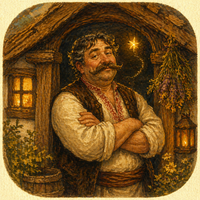
Village tale 10 parts
The Mirror That Never Saw Love
Translated from the Ukrainian original. Read the original in Ukrainian
A mirror doesn't lie - I've heard that more than once. Don't believe it. It's not only people who lie. Old clouded mirrors lie too, if you look into them with pain for too long. In our village lived Marichka, who every morning stood before such a glass and searched in herself for a reason not to go out among people. The mirror hung by her window. Darkened, with a blotch in the middle, it always laid a shadow across her cheek.
Marichka would straighten her kerchief, look at herself and say quietly: "The vechornytsi are not for me." And outside the musicians were already playing, and the girls laughed as if the whole world around were young. She wasn't cruel to herself. No. Worse. She was used to it. Used to sitting in the corner while others danced. Used to lowering her eyes when the lads joked. Used to thinking that joy has a door, only for her it never opens.
That's how people sometimes grow old before their first grey hair. Levko had loved her for a long time. Not loudly, not for show. He would bring her an apple from the orchard, cherries, a ribbon the color of the morning sky. Once he brought a warm heel of bread and said: "You laughed by the well today. Even the water turned clearer." Marichka turned away: "Don't make things up, Levko."
At the vechornytsi he kept holding out his hand to her. Not with the gesture people use to take what they mean to carry off. But the way you call someone who has the right to be near. Marichka would look at his palm and shake her head. "That place is for the pretty ones." Levko only answered quietly: "I'm not calling you to the pretty ones. I'm calling you to the living."
Once, by the old cherry tree, he said to her: "Marichka, beauty doesn't always live where people go looking for it. You look into a mirror, and I look at you. And I see more truth than that glass does." She smiled sadly: "You're just being kind." And he shook his head: "No. I just look without malice." The years went by. The cherry tree blossomed and shed its blossom. The musicians at the vechornytsi fell silent and struck up again.
More and more often Marichka sat by the window. She watched other people's joys pass along the road: weddings, christenings, songs, young hands in young hands. And her own she kept folded on her knees, as if begging life's forgiveness. When illness laid her in bed, Levko was already grey at the temples. Every day he sat beside her and read aloud, though what she loved to listen to was not the words but his voice. One morning Marichka asked: "Carry me outside. Into the sun.
I've hidden from it so many years I've forgotten how it touches a face." Levko carried her out to the bench under the cherry tree. The sun laid warm palms on her cheeks. The air smelled of blossom, of grass, of apples and of far-off water from the pond. Marichka closed her eyes, the wind brushed her face, and then suddenly she remembered it all: his apple, his ribbon, his hand at the vechornytsi, his gaze in which she had never once been unwanted.
She was silent for a long while, and then she whispered: "Levko... maybe you really did see me better than I saw myself." He smiled, but his eyes went wet. "No, Marichka. I simply saw you not with fear, but with love." For the first time in many years she laughed lightly. As if a heavy old kerchief had been lifted off her.
Before evening came, Marichka was gone. Quietly, without a struggle. Only the sun lay a long while yet on the empty bench under the cherry tree, as if it didn't want to leave. And Levko sat holding in his hands that same ribbon the color of the morning sky, the one she had never dared to weave into her hair. I don't put much faith in mirrors. They show a face, but they don't always see the person.
Beauty truly does often live in the eyes of the one who looks with love. But at least once, you have to let yourself believe that gaze. The light of life doesn't ask whether you're enough for it. It simply shines. And it's a terrible thing to answer it too late.
Your verdict
Did you like this village tale?
Be the first to rate this tale.
If the story touched you, the inn will be grateful.