Village tale 22 parts
Ruslan and the Great Communal Puddle
Translated from the Ukrainian original. Read the original in Ukrainian
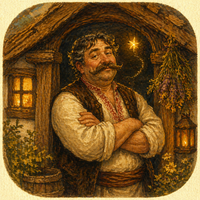
There are heads of the community who, the moment they say "for the people," make the people grab their pockets at once and look to see where that man's house stands. Old Yakiv told me this story when he came into my inn-and-shop for salt and kvas. Though "told" is hardly the word - I saw it all myself, because it happened in our village, where Ruslan had just been elected headman. Not a wicked man, no.
Just so caring that after his caring, things at his own place always got drier, smoother, and closer to his cellar. Ruslan loved to say: "The community is one big family." And he said it so sincerely that people almost believed him. Then he would take a stick, draw a plan on the ground, and every time that stick reached toward his own gate all by itself. Ruslan would sigh: "You see? Even the earth knows where order should begin."
One day the village asked him to level the road to the church. Because after the rain Baba Motria got so stuck in the mud that by the time they pulled her out, she had managed to quarrel with three saints, one gander, and her own left galosh. Ruslan nodded: "A road must serve everyone." And he laid it from the church to his own cowshed, past his own orchard, alongside his own cellar, and only then somewhere toward the people. People ask: "Why is the road so crooked?"
Ruslan spread his hands: "Because our folk are no simple folk. Each one has to be gone around with respect." After the rain the whole village was kneading mud again. But the headman's wife walked to the henhouse dry, like a lady across a bridge. The children ran about shouting: "The road is communal, but only Auntie Headman's-wife has dry feet!" Ruslan smiled into his mustache. He thought it was the people's love.
He had a rare gift altogether: when people groaned, he heard gratitude. Then the old well began to run shallow. A new one had to be dug. Ruslan walked around with a dowsing rod, squinting, listening to the earth, turning his head so gravely, as if the water itself were supposed to whisper: "Dig here, Mister Headman, right by your window." And so it happened. He jabbed a finger right under his own house: "The water is purest here. It's not for myself. It's for the community."
They dug the well. And now the whole village came for water every morning under Ruslan's windows. Buckets clatter, geese hiss, old women carry the news, children fall into puddles. The headman's wife was the first to break: "Ruslan, your communal benefit won't let me sleep." And he to her: "Bear it, woman. That's the people's gratitude knocking with its buckets."
Tolia, a lad as simple as a wooden spoon, was carrying a bucket and suddenly said: "Maybe our community just looks an awful lot like your yard?" Ruslan frowned. Paraska glanced at him from the queue and said: "When a man cares about everyone very loudly, I always check whether he's carrying something into his own cellar." For some reason the queue laughed, and Ruslan pretended it was just the water gurgling. In spring the water came for the gardens.
Ruslan called the council together: "We must save the people's labor!" They raised a dam. A fine one, sturdy, almost wise. Only the water went around Ruslan's cabbage and headed straight for Motria's garden. Motria stands knee-deep in mud and asks: "So my cabbage is the community now?" Ruslan shouts from the hillock: "It took the blow for everyone!" Motria didn't think long. That night she took a spade and quietly taught the water some justice.
In the morning Ruslan ran out barefoot, and under his cowshed stood a little lake. In it floated a wood chip, a cabbage leaf, and one very pensive hen. "The elements have betrayed the community!" he cried. Motria leaned on her shovel and smiled: "No, Ruslan. The community taught the water to come home. Because home is sacred." The headman would not settle down. They decided to put a little bridge over the stream, so people could walk to the fair with dry feet.
Ruslan draws up the plan. The bridge goes over the water, sort of, but somehow it politely turns toward his cellar. People ask: "Whose prosperity is that bridge looking for?" Ruslan coughed: "The community's. It's just that while the community is getting itself together, the prosperity is lying at my place for the time being. For safekeeping."
At the bridge's grand opening, the first to cross was not a man but Ruslan's pig. Because now it was convenient for her to visit the neighbor's garden. Tolia clapped his hands: "Look, the bridge is already serving the community!" Paraska looked at the pig: "If our community grunts, then it's serving." And that very day the children began playing headman: one stands with a stick, another drags apples toward himself, a third says: "It's all for the people."
In summer came the heat. They decided to plant lindens along the street. Ruslan solemnly declared: "People need shade, for the folk are drying out under the sun." They planted them. And what do you think? The thickest lindens grew by his yard, his bench, his cellar, and the spot where after dinner he "thought his deep thoughts."
Baba Nastia wiped her brow and said: "Strange that such an expensive head always does its thinking in the cool, while our cheaper heads can go on baking." The children named his yard "the communal shade with the headman's fence." Ruslan got angry, but secretly he was pleased, because he liked the word "communal." It suited everything of his: the communal pear tree, the communal bench, the communal cellar, the communal peace of the headman after dinner.
Then he announced a toloka, a common workday: "We must all put the village in order together." The list was a fine one: the ditch by the headman's, the fence by the headman's, the road by the headman's, firewood temporarily at the headman's, the yard by his cellar to be cleared of stones, the pear tree to be propped up, because it too, as it turned out, was a "provider of the people." The village kept silent.
Because it could see: the whole toloka was going in circles around Ruslan's pear tree. Paraska said: "And order, I see, begins at your cowshed and ends by your woodpile." Tolia suggested putting up a sign: "Here the community works, and the headman worries." Ruslan took offense. But he accepted the firewood. So as not to hurt people's feelings. Hens began disappearing in the village. Ruslan set up a night watch "for safety."
He posted the men around his own yard, his hay, his henhouse, and his pear tree. People ask: "And our hens?" The headman waved a hand: "If the thief doesn't get past me, he won't reach you either." The thief, apparently, was a well-mannered man. He didn't go past Ruslan. He went around his yard and took the hens from everyone else. In the morning Ruslan said proudly: "You see, the watch works. Nothing was stolen near me."
Motria laughed: "Because your watch guarded your pear tree so well that the thief was quite touched and went off to the people, so as not to disturb such a respectable business." And this time the village didn't get angry. It was tired of being angry. Because there is a certain line: beyond it, cunning stops being frightening and becomes funny. Especially when it stands by its own cellar and thinks nobody can see it. That night the people came out into the street.
Old women, men, children. Without shouting, without cursing, even without Motria's singing, which was a miracle in itself. They took apart his "wise" dam, stripped the planks off the "communal" bridge, and re-laid the streambed so that all the water politely went around the people's gardens and made a lap of honor around the headman's house. They weren't taking revenge. They were teaching. Because a community is not only patience. It is also memory with a shovel.
In the morning Ruslan came out barefoot and stepped straight into a puddle at his own door. His yard had turned into an island, and where the fence had been, there was now a moat. He wanted to shout, but on the only dry porch he saw wool socks knitted by Motria and a jug of hot uzvar. He took the socks, and his hands trembled. For the first time the headman understood: the community knows how to plan too. Only its care doesn't shout. It silently warms your feet.
That day Ruslan came to my inn wet and quiet. He hugged the jug of uzvar as if it were the last honest thing in the world. He says: "People have stopped understanding care." I set bread before him. Paraska smiled from her corner: "No, Ruslan. People have finally understood where your care lives." Tolia asked at once: "By the cellar?" And the whole inn laughed. Ruslan laughed too. Not right away, but he laughed.
Because he understood: him, the fool, they hadn't driven out, hadn't drowned, hadn't whacked with a wet plank, though some, perhaps, had been thinking about it. They got him into dry socks, gave him a drink, and let him step, all by himself, into the very water he had so diligently been steering away from the people. And that's how he learned: when you say "for the community," don't drive the first peg in by your own fence. Because a real deed leads to the people.
And if every time it leads to your cellar, then it's not a deed. It's just you fetching water in a very cunning way. And we're all a little bit Ruslan. Every one of us, at least once, has cared for the world in a way that made a softer seat for himself. It's a good thing when there's a community nearby that won't drown you but will set out dry socks. Though first, without fail, it will let you step barefoot into the truth.
Your verdict
Did you like this village tale?
Votes so far: 2
If the story touched you, the inn will be grateful.