Village tale 10 parts
The Delights of a Master of Words
Translated from the Ukrainian original. Read the original in Ukrainian
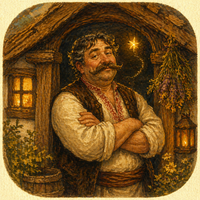
Trokhym flew across the whole village, clutching a clean shirt to his chest, and greasing his moustache from a little bottle of oil as he ran. By the well one neighbor decided he had borrowed money, a second had already "sold" his cow for him, and a third counted up his sins all the way to Spas. Marfa still knew nothing. That was the most dangerous part!
So, how it all began. At the fair the old miller, selling his sacks, was telling anyone who would listen that a real man, before conjugal love, always reads the lady poetry. Trokhym stood nearby with a shoulder-yoke and said nothing for a full five minutes, which for him is a record. Then he tossed the yoke into a neighbor's hands and said he urgently had to see Ivan - for paper and ink, because at my inn you can find anything for a few coppers.
He came running in, sat down at a table and announced that he had loved Marfa for twenty years without the proper science, and now it was time to mend his ways. I offered him the moon - too skinny. The stars - too far away. Spring - makes mud. Trokhym waved his hand and said he would write about what was truly precious: good food, a sturdy farmstead, and a woman who wouldn't crumble at the first gust of wind.
When he asked what rhymes with the word breasts, I quietly moved the inkwell away. He wrote out solemnly: Your eyes are like plums in uzvar, I look at them and forget about the door. Then he added something about a figure as dependable as a good barrel. I carefully remarked that a woman is better not compared to a barrel. Trokhym drew himself up. And have you ever seen a good barrel let a man down?
Then he tucked the sheet inside his shirt and ran off for a clean one, already certain the poet in him had ripened for good. At home he doused himself with water, washed his neck twice, oiled his moustache once more and pulled on the shirt as if he were going to see the lord himself. He set a candle on the windowsill, and on the pillow he laid a flower stolen from Baba Palazhka's garden. Marfa walked in, took one look and asked straight out: do you owe somebody? No.
Sold the cow? No. Praying off a sin? No. Then why are you clean in the middle of the week, Trokhym? He sat Marfa down on the edge of the bed and announced that from now on he would love her like the gentry do. He read the part about plums in uzvar, drew a breath and added: Your cheeks are like beets after a warm rain. Marfa folded her hands in her lap and asked, boiled or raw. The candle twitched. Young ones, Trokhym breathed out. Fresh from the garden.
He got to the words Your breasts are two festive kalachi, and your figure is dependable as a good barrel, and lifted the sheet even higher, as if that would give the words weight. Marfa sucked in her lips, her shoulders began to shake, and then she collapsed onto the pillow in fits of giggles. Who taught you this, Trokhym? The miller, at the fair. Read on, only leave the kalachi till Sunday, please, or my heart won't hold out.
Marfa blew out the candle, pulled Trokhym closer by his clean sleeve and whispered: As a poet, husband, you're about as good as I am a dancer. But the man in you isn't entirely lost yet. Put the paper under the pillow and keep quiet - if the village finds out about your kalachi, I won't leave the house till Pokrova. And the village did laugh. Just not at the kalachi.
In the morning Marfa pinned the flower to her kerchief and went for water. By the well Palazhka recognized it at once - that very mallow she had kept by her house in memory of her husband. - And who gave you such a beauty? - Trokhym. Courting me like the gentry. A minute later Trokhym was already flying across the whole village in nothing but his shirt, with Palazhka chasing after him, a stick in her hand.
A true romantic, you know, that's our man: he composed the verses himself, took the flowers from someone else, and received his inspiration on the run - from behind.
Your verdict
Did you like this village tale?
Votes so far: 1
If the story touched you, the inn will be grateful.