Village tale 15 parts
The Khatnyk Who Knew About the Vyshnivka
Translated from the Ukrainian original. Read the original in Ukrainian
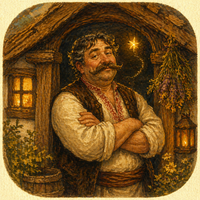
Three things you can never hide from a woman: spare money, a bad mood, and a bottle of vyshnivka. Old Panas from down by the Sula thought he had a talent for hiding vyshnivka so well that afterwards he'd search for it himself, with respect. But there was one more resident in his house. A khatnyk. And that one, it seems, knew not only where the stove stood, but where the old man's conscience spent its nights.
A khatnyk is not just any house spirit. He's a household inspector. One night Panas went off to his hiding place, tripped over his own boot, nearly fell into the tub of sauerkraut and grumbled: the khatnyk's up to mischief again, the little devil! And that time the khatnyk was simply eating a crumb of bread behind the stove. And he took offense. That sort of thing they don't forgive.
He can put up with cold kasha. He can put up with them forgetting to leave him milk. But when the old man's crooked walk to his nightly "medicine" gets pinned on him - that means war. And the khatnyk, house spirit though he is, doesn't sit in the house alone. He has a whole brotherhood: the mouse knew the pantry, the cat knew all the warm spots, the rooster knew where to crow the loudest, and the old door creaked only when it had something to say.
Panas hid the bottle behind the stove. In the night the khatnyk laid out a trail of bread crumbs from the bench straight to the hiding place. In the morning Marfa sees the trail and says: Panas, either our mice have learned their letters, or you've been taking your medicine again. The old man stands there blinking, and from behind the stove comes such a quiet rustling, as if someone very small were trying very hard not to laugh.
The old man decided to play it craftier. He hid the vyshnivka in an old boot under the bench. But in the night the little one dragged that boot out into the middle of the house and set it down toe-first, pointing straight at Marfa. There stands the boot like a witness in court: silent, but it has already said everything. Marfa took one look and asks: Panas, why is your boot staring at me as if it wants to confess?
Then Panas moved the stash outside the house. He put the bottle in an old beehive that hadn't seen bees for three winters. He thinks: now the khatnyk can't reach it - he belongs to the house, after all. But that night such a humming rose from that hive, as if the bees had risen from the dead and gone straight back to work. Marfa woke up, sat up in bed and says: Panas, do you hear that? Something's humming out in our yard.
Either the bees have come back from the other world, or somebody very much wants me to go out there. Out she went, listened, walked up to the old hive, lifted the lid - and there stands the old man's "medicine", quiet as can be, only the cork smells guiltily of cherries. Panas clutched his head. Says: this is no khatnyk anymore, this is a whole administration. I carried it past the threshold, and it still reported back home.
A khatnyk, you see, may belong to the house, but when justice is called for, even the cat, and the mice, and the rooster serve under him on a volunteer basis. Panas no longer knew where to turn. He hid the bottle in a pot of beans on the sleeping platform in the pantry. And in the night the little one spelled out the word HERE in beans. In the morning Panas saw it and rushed to clear it away, but Marfa was already standing behind him with the oven fork.
I only wanted to sort the beans, Marfa, - the old man babbles. Right, - she nods. Especially the ones with the cork. That night Panas decided to negotiate. He set a bowl of kasha behind the stove, a piece of salo, and whispers: friend khatnyk, let's make peace. Kasha for you, silence for me. In the morning the old man wakes up well pleased. Then he glanced at the new hiding place, and there lies the spoon in the bowl, handle pointing straight at him.
Because the little one takes no bribes. Especially not kasha without butter. Then Panas moved on to the great peace. This time he set out kasha with butter, added salo and even a crumb of pie. He sat down facing the stove and says: brother khatnyk, I come to you man to man. You give me quiet, I give you supper. And in the morning, traced by a finger in the flour on the table: don't lie to Marfa. The little one wasn't demanding salo. The little one was demanding justice.
Marfa, for her part, was not merely a punishment armed with an oven fork, but a clever woman. She says to him one day: Panas, I'm not against you having a shot. I'm against you thinking me dumber than an old boot. Say it honestly: you wanted one. But if you tell me one more time it's for your health, I'll pour it into the washtub. And the old man understood: Marfa may well have known plenty on her own. But the khatnyk was shortening her road to the truth.
Panas looked at the stove, from which came a quiet, satisfied rustle. He looked at Marfa. And he understood that a war against the house was one he could not win. Because a woman sees more than a man thinks, and a house knows even more than a woman asks. The old man stopped hiding his liqueur. He took the bottle down from under the rafters, wiped off the dust and set it openly on the shelf next to the makitra. Let it stand there.
In the evening Panas sat down at the table, poured himself a small shot and says: Marfa, I have a bottle of liqueur. Not against death, not against drafts, not for my health and not for gloom. I just wanted it. May I have a small shot after supper? Marfa stopped, looked at him, sighed and smiled with the corner of her mouth.
A small one you may, - says Marfa, setting a bowl of hot borshch on the table. But the moment you start doctoring your soul, your back and the weather with it, then I'll be the one doctoring you. Panas drank, chased it with salo, and felt the house grow warmer. From the direction of the stove came a quiet, satisfied laugh. The khatnyk calmly finished his bread and curled up in a ball in a warm corner. From then on Old Panas drank more rarely, but more peacefully.
Because he had understood one simple thing: the worst thing to hide in a house is not a bottle, but the truth. A bottle can still be found behind the stove, in a boot, or in the hollow of a pear tree. But the truth, when it lies too long in a dark place, begins to smell so bad that even the khatnyk wrinkles his nose.
Your verdict
Did you like this village tale?
Be the first to rate this tale.
If the story touched you, the inn will be grateful.