Village tale 12 parts
The Painter Who Saw Memory
Translated from the Ukrainian original. Read the original in Ukrainian
Some people see beauty in a flower, in the sky, or in a smile. Our Ostap saw beauty wherever his paint happened to drip. And he didn't just see it - he explained it with such gravity that people forgot, for a moment, to laugh. It was Tolia who brought him up after the second shot: first he roared with laughter till the spoons rattled on the table, then went quiet and said: "Now there's a man who can't hold a brush, but with words he could walk a pig into heaven."
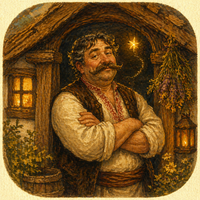
Ostap had got it into his head that he was a painter. He'd paint a crooked house and say the house wasn't crooked - it was carrying its fate on its shoulders. A fence with missing pickets wasn't forgetfulness, it was "room for the wind". And a blue cow - because, you see, her milk had been feeling sad. The village mocked him, but listened gladly. For who else would tell you that a stain on the wall wasn't damp, but the shadow of last summer that hadn't wanted to leave?
Motria mocked him most of all. A woman sharp as a winter wind and tongued like a market trader. She says: "Ostap, paint me a goat, so I can see whether you can tell horned cattle from a head of cabbage." Now Motria had a goat, Riabukha. Not just livestock, but a true nanny to her mute grandson Petryk. The goat was a proper hooligan: she ate other people's clothes and butted the neighbours' dogs.
But the boy could only fall asleep with her in the shed, his arms around her warm, hay-scented side. Then in autumn the goat took sick and quietly passed. Motria went about blacker than a storm cloud, but in public she only chirped her tongue all the more spitefully, hiding a bare, defenceless grief behind the cursing.
Ostap saw this. Said nothing, only nodded. He shut himself in the storeroom, got out old boards, mixed paints he'd pounded himself from clay, cranberries and soot from the chimney. For a week no one heard a sound from him. Only the smell of oil, smoke and a little honey mead drifted from under the door - that was Ostap, they said, washing his brushes, and his soul along with them.
The village was already rubbing its hands: any moment now he'd produce something that would have Motria chasing him with a broom all the way to the high road. I saw it myself, how she came into his yard, arms crossed on her chest like two flails. "Well," she says, "show me your masterpiece, Michelangelo. Let's see if you managed a goat, or if it's 'the burden of fate' again." Ostap brought out his creation. There was no goat in it.
There was a solid jumble of warm russet blotches, rough lines, and some strange, blurred golden light in the middle. Motria went red with fury. - What is this, - she says, - are you mocking me? Where are the legs, where are the horns she used to knock my towels down with, where's the udder?! That's no goat, that's a sack of rotten potatoes dropped in the mud!
Ostap only wiped his hands on his apron, looked her straight in the eye and answered quietly: - Motria, you needed the horns in your garden, not in a picture. And the udder is for milk. But what did she warm your grandson with, when he woke at night from his mute nightmares? Warmth. This russet blotch - that's how she breathed on the back of his neck. And this rough edge - that's how he ran his fingers through her ears when he was frightened.
I wasn't painting livestock, Motria. I was painting the tenderness that trembled between them. Motria froze. The anger drained from her face like mist off a river, and only the bare, defenceless grief remained. Then her grandson came out from behind the house. He walked up to the board, reached out a small palm and laid it right on that warm russet blotch. He couldn't speak, but he pressed his cheek to the rough wood, closed his eyes and breathed in deep.
And in that silence, in the middle of the yard that smelled of fallen leaves and smoke, everyone suddenly saw not crooked lines, but a real, living love that cannot speak, yet knows how to warm. Motria only bowed her head, covered her face with her hands and quietly wept. From that day on, no one criticized Ostap's pictures. People had understood one simple but great thing. Anyone with steady hands and good eyesight can paint the way the eye sees.
But we don't remember the people and animals we loved down to the last hair or the spot on their side. We remember their warmth, their smell, the weight of their paw, their little hoof, or even their claw on our shoulder. Real art is not copying the world. It is translating the invisible into the language of the visible. Paint peels with time, but warmth...
warmth, if it's laid on right, keeps you warm even through the paint. Tolia just shakes his head, exhales and reaches for a shot glass. "To Ostap, - he says. - And to each of us having someone who'll paint not our hide, but our soul."
Your verdict
Did you like this village tale?
Be the first to rate this tale.
If the story touched you, the inn will be grateful.