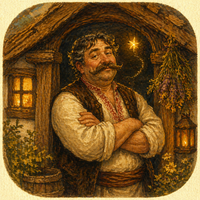
Village tale 21 parts
Baba Dokiia and the Dangerous Spoon
Translated from the Ukrainian original. Read the original in Ukrainian
At the fair people sell all sorts of things: kerchiefs, jugs, hens, old icons and fresh gossip. But the most precious thing there is not the goods. The most precious thing is time, because when you need very badly to make a quick dash for the nearest bushes, there will always be an old man who wants to haggle slowly, respectfully, and by all the laws of the ancestors. That is what happened to Baba Dokiia.
Dokiia was a woman of standing. She healed with herbs, poultices, whispered charms, and a look that could make even a spine straighten up and ask whether it might go back to work now. People came to her with everything: one with a twisted back, one with a husband who'd let his tongue run loose, one whose cow had stepped on their soul.
And then one morning Dokiia woke up and understood: trouble. She coughed - and it sounded as if she'd spent three days singing over the dead, and on the fourth they'd sent her up to the choir as well. The trouble was small but treacherous. After yesterday's church singing and the quarrel with the deacon over her crooked voice, her throat hurt. And a healer's throat is a working tool.
With it you must whisper, scold, bless, frighten illnesses away, and explain to foolish people that they are fools, but not yet hopeless ones. Dokiia laid a hand on her chest, coughed, and said: - It needs greasing. In the entry hall stood a jug. Not just any jug. It held Galician sour cream, brought over the day before by a relative. Dokiia called it the sour cream of holy Halychyna.
Not because a priest had sprinkled it, but because it was so good that after the first spoonful a person began to believe life still had meaning, and so thick that a spoon didn't sink in it but stood upright, like the headman at a village meeting. Dokiia ate one spoonful "for the throat." Then a second - "so the voice would come back with honor." A third - "so the whisper would be soft." A fourth - "so the illnesses would hear me and be afraid."
And after that her hand went on by itself: Dokiia was only just thinking "enough," and the spoon was already standing in the jug again, like a matchmaker on the doorstep. And so half the jug vanished - not out of greed, but strictly for medicinal purposes. She wiped her lips, decided her voice really had grown gentler, and said: - Now that's medicine. Not like your bitter tinctures that leave the tongue an orphan.
Her belly listened attentively. And then decided it, too, had the right to be heard. Dokiia set off for the fair to buy a woolen kerchief. She wanted one that would keep off the wind, keep off the evil eye, and show the neighbor women that the healer wasn't old yet, but wise and wrapped in warm cloth. She had barely stepped in among the wagons when something restless began in her belly. First quietly, as if someone had shifted a bench.
Then louder, as if in the inn the innkeeper, the headman and three widows nobody had asked all started talking at once. In her gut the tsymbaly struck up. Then a drum. Then, it seemed, a small trembita. And under her heavy skirts a whole band of Hutsul wedding musicians was already begging to be let out. Dokiia stopped, drew herself up and made a face as if she had just seen an angel. In fact she had seen a far more practical vision: the lilac bushes behind the last cart.
But between her and those bushes stood Did Myron. Myron was selling the kerchiefs his wife wove. He stood by his wagon proud, dignified, thumbs tucked in his belt, as if nothing less than the sunrise over the Carpathians depended on him. For Myron, haggling was not selling. Haggling was an art, a service, and a way of proving that he was still alive, still cunning, and still able to drive a person to distraction in the kindest possible way.
Dokiia approached Myron with her whole body taut as a bowstring, because she knew: relax a single muscle now, and the fair would see something it hadn't seen since the village was founded. - How much for the kerchief? Myron named a price in coppers. - I'll take it. Myron went white. - Dokiia, what are you doing? - Buying. - I can see you're buying. But how?! Where's the "too dear"? Where's the "you're robbing me blind, you old devil"?
Where's the "to blazes with you and your price"? What is this, contempt for the fair? Dokiia smiled the smile of a person whose insides are already drafting a last will and testament. - Myron, take the coppers. - No, - said Myron firmly. - That won't do. I'm not some town shopkeeper, to hand over goods in silence. We have an order here.
I say it's too dear, you take fright, I take offense, you walk away, I call you back, we both shout, people watch, and then God sees the fair is alive. She stood there as if she were not a woman but an overfilled pond where the dam is already praying. - Myron, I'll give you double the price. Myron crossed himself. - Double? Woman, you're burying me in front of everyone!
If I take double without haggling, tomorrow they'll say: Myron's no gazda anymore, just an old pear tree that even the wind can't shake fruit out of. Then all that's left for me is to lie down on the stove and wait while the hens divide up the inheritance. Dokiia inhaled. At that moment her belly inhaled too, but somehow menacingly.
- Myron, - she said quietly, - right now my soul is standing off to one side, praying for you to shut up. And my body is already coming to terms with the nearest bush. - Oh! - Myron rejoiced. - Now that's starting to sound like a haggle. There's pain in the voice. But we need more offense. The woman was ready to spit on the kerchief, on the haggling, on the whole fair, and run to where people ask no questions. But suddenly she looked at Myron.
The old man wasn't just standing there being stubborn. He was positively glowing because he was still needed. Because someone was still haggling with him. Because he wasn't just an old man beside a cart, but the master of the fair. She understood: Myron wasn't holding on to the coppers. He was holding on to an order of the world that mattered to him.
For him, haggling was conversation. Exercise for the tongue. Proof that he was still here. That he could still knock off two coppers as if bestowing half a kingdom. That he could still take offense, turn away, call her back, and defeat the loneliness beside the wagon. Dokiia drew in air, but didn't risk relaxing her knees. - All right, old man. Let's do this properly. And she began to haggle.
- You're robbing me, Myron! - Oh! - the old man blossomed. - At last I hear a living person. - For coppers like that, this kerchief had better not just keep me warm - it should ward off the evil eye, count my hens, and hold a candle for me in church! - Now that's a fair, Dokiia! At such respect for tradition her belly went quiet for a moment. It, too, must have decided it would be a sin to spoil the rite now that the old man was finally happy.
Myron knocked a little off. Dokiia was outraged. He took offense. She took two steps back, very carefully, because the third might have gone down in history. Myron called her back. She returned. He knocked off a little more. She said he would drive her into her grave. He replied that with a kerchief like this it would be warm even in the grave. Everything just as it should be.
And when the kerchief finally passed to Dokiia, she flung down the coins, snatched it up and bolted so fast that the roosters by the cart nearly laid an egg apiece from fright, and the mare sat down on her haunches. Myron watched her go for a long while, shaking his head and telling the neighbors: - There's a gazdynia for you. Haggled as if she were pawning her soul. A woman of standing.
And Dokiia said afterwards that her soul - maybe not. But her skirt - most certainly. Still, her conscience was clean. That's how it goes: a person may need to run so hard their ears flap, and still they'll stop for a minute to let an old man feel needed. The heart, even when the belly is already drafting a decree and demanding rebellion, sometimes manages to be kind.
So in everything one must know the measure: in haggling, in pride, in healing, and even in sour cream. Listen to the healers, honor the old, and haggle like a human being.
Your verdict
Did you like this village tale?
Be the first to rate this tale.
If the story touched you, the inn will be grateful.