Night tale 11 parts
The Forest That Asked for a Human Voice
Translated from the Ukrainian original. Read the original in Ukrainian
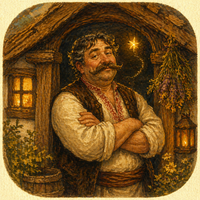
The rain today is the kind that even a dog won't poke its nose out from under the eaves. Sit closer to the fire, girl. I heard this story from an old chumak who once lost his way in the Polissia bogs in a hungry year. He trembled not from the cold but from the memory of a village where the earth had stopped bearing, and the forest seemed to have begun asking for a human voice.
People ate bark, boiled their leather shoes and dried on the stove things that in a good year even the pigs wouldn't have sniffed at. At the edge of the village, by the quagmire, lived an old woman. A sweetish-bitter smell drifted from her house: burnt hair, old fat, and something that did not want to have a name. The villagers shunned her.
Because when she passed down the street, the cattle went quiet, as if their tongues had frozen solid, and the dogs hid their muzzles in their paws. Then the children began to disappear. At first they blamed the wolves. But the forester kept finding small bones in the thickets, too clean for any beast. Not scattered, not gnawed, but laid in little piles under the roots, as if someone, after terrible work, had still had the patience to tidy up after themselves.
And one evening a mother heard from the bog the voice of her missing daughter. The child was calling her by name, but the voice was thin and hollow, as if someone had taught the reeds to speak with human grief. A shepherd boy, out looking for a goat, wandered up to the old woman's house. A yellow light flickered in the window, and steam drifted from inside. The boy stood against the wall and peered in.
The old woman stood over a cauldron, stirring something with a long black spoon. She was humming a lullaby, only not in one voice but in three children's voices at once. In the dark broth something stirred beneath the surface, and stuck to the rim of the cauldron was a yellow ribbon - the kind girls have plaited into their braids for a feast day. Under the boy's foot a dry twig snapped.
The old woman turned slowly. Her face was neither old nor young, but as if put together from other people's smiles that no longer belonged to anyone. Where the eyes should have been, wet hollows showed black, and something glistened in them, like leeches at the bottom of a well. She did not scream. She did not lunge. She only smiled and nodded to the boy, as if she had known him for a long time.
He ran, but from that night on he tore at his throat with his fingernails and screamed that the old woman had planted a little seed in him that stirred whenever children sang. The villagers took up pitchforks and tarred firebrands. They walked to the house in silence, for every word in that stillness might have sounded like someone else's. The door stood open. No one inside.
Embers smouldered in the stove, something bubbled softly in the cauldron, and on the bench lay a small sheepskin coat, folded so neatly it seemed the child was about to come back and put it on. But the most terrible thing was on the floor: ash covered the earthen floor, and across it ran dozens of small bare footprints. From the cauldron to the wall. Up the wall. And on across the ceiling, where they vanished into a black corner.
The old woman was never seen again. That year the famine retreated, and the next spring the earth bore again, as if someone had at last unclenched it from a hungry fist. But in that village the children still do not go to the forest alone, and the old people never leave the house at night without a candle.
Because when the wind settles under the floorboards, you can sometimes hear a soft many-voiced humming down there - as if someone were rocking something that should never have woken again. From then on, in that village, the children did not go to the forest alone, and the cauldrons were turned upside down for the night. Not because they believed in the old woman. No. People always say they don't believe when they are very frightened.
But the moment the sweetish smell drifted in from the bog, every mother silently laid her hand on her children's heads and counted her own: one, two, three... And only then did she put out the candle.
Your verdict
Did you like this night tale?
Votes so far: 2
If the story touched you, the inn will be grateful.