Night tale 13 parts
The Staple Under the Old Boundary
Translated from the Ukrainian original. Read the original in Ukrainian
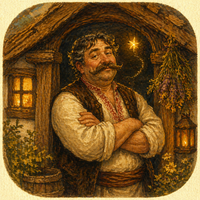
There are nights when the darkness doesn't fall from the sky but crawls out from under the very floor. Then the fire in the stove doesn't warm, it only trembles, as if afraid of someone breathing down the chimney. The inn grows so quiet you can hear the wax cooling on the candle. Move in closer to the fire. Because out there, beyond the threshold, in the black ravine, stands something that has no eyes but is watching us closely.
This true story was told to me by an old land surveyor who measured out boundaries beyond the Dnipro. He came to us on Pokrova, when the puddles were already filming over with ice. His coat reeked of raw earth, and from inside his shirt came the bitter smell of blessed wormwood... He measured plots not by paces but with an old measuring chain.
That was when he told me why a boundary should be sprinkled with vydiuk poppy, the seeing poppy, and why you must never pick up another's belongings from the ploughed field. It happened when the surveyor himself was still young, and his measuring chain had not yet been worn smooth by the steppe stones. On one khutir the rye grew so tall a rider could hide in it head and all. But the people had an unwritten law - never touch the last furrow by the old burial mound.
It was no mere hillock, but the place where they buried those who were not carried to the church. Yet one farmer decided to cut his plough into that boundary. In the morning the plough caught on something and stopped. The farmer dug the earth away with his hands and pulled out an iron staple from a coffin lid. Rusty, bent like the claw of a giant bird.
There was no cross on it, only deep scratches on the inner side, as if someone had scraped at the boards from within, trying to get out. He laid it on the earthen bench by the wall without even washing his hands, and a breath of ice came off that spot. At first they thought the chumaks had dropped it. But within three days the rye along that boundary began to wither. Not from the sun - as if it were being drained from under the earth.
And at night the watchman heard a sound by the mound. Steady, heavy. Scrape... scrape... As if someone were slowly dragging rusty iron across dry bone. The watchman crossed himself and ran, because the sound was coming closer, and it smelled of grave-cold. The surveyor was called in to see whether the boundary had shifted. He opened his book with its wax seals, but instead of records he saw thin black rootlets on the parchment.
They had sprouted through the ink, pulsing like veins. And when he went over to the earthen bench - the staple was gone. Only a handful of wet mould lay on the ground, and it smelled of an old, deep cellar. The next day the staple lay in the farmer's house. Right on the table, beside the bread. The bend of the iron was packed with grey earth and small, sharp bones. The farmer threw it into the stove, but the fire choked at once and went out.
And what came from the chimney was not smoke but that same sound - scrape... scrape... Then he snatched the staple up in sacking and ran to bury it back in the field. But the earth does not like being given back what it has already taken as payment. In the night a low ground wind rose. The surveyor, who had stopped for the night in the house of the village headman, woke from a piercing cold. The candle had gone out, but in the darkness he heard it - scrape... scrape...
The sound was not coming from the field. It came from just beyond the thin wall, right under the window, and someone was breathing heavily on the glass. The surveyor stepped out onto the porch, holding a lit bundle of that same blessed wormwood. The light tore a figure out of the darkness. It was that farmer. He stood with his back to the house, looking at the mound. And slowly dragging the rusty staple across his own chest, tearing his coat open.
But instead of blood, what spilled from under the iron was dry, brittle rye and black, damp earth. The surveyor did not call out. He knew - when a man begins to plough his own body, he no longer hears human voices. He hears only the roots sprouting through his ribs, and the earth drinking the autumn rains. The farmer stood like that until first light, until his eyes filmed over with frost.
And then he simply walked off into the rye, rustling with dry stalks instead of footsteps. All that remained was his house and that furrow by the mound. People never touched that boundary again, and on Pokrova they always leave a handful of poppy seed there. The surveyor said that a year later he found in the earth only a brass button from the coat and the rusty staple. Around it white roots had woven themselves tight, forming the exact shape of a human heart.
And when the wind touched those roots, they slowly clenched and eased again, as if still trying to hold someone else's breath inside. So when you walk across ploughed land, watch your feet. If you see rusty iron - don't touch it, just spit over your left shoulder.
And here in our inn, while the wind is scraping at the thatch like that, I'd best cover the flour barrel with an overturned rushnyk and lay a sprig of lovage on top. For the night is long tonight, and the field isn't sleeping either, waiting for a new furrow.
Your verdict
Did you like this night tale?
Votes so far: 2
If the story touched you, the inn will be grateful.