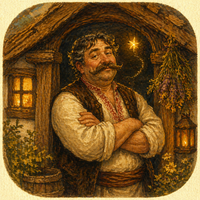
Night tale 16 parts
The Old Man with the Damp Palm
Translated from the Ukrainian original. Read the original in Ukrainian
Do you know those nights when the silence doesn't come down from the sky but rises from under the earth? Old, damp and blind. At such an hour the oil lamp burns steady, as if afraid to blink, and beneath the inn's floor you can sense the breathing of something that scorns human names. The old man I'm going to tell you about never asked for names. One palm was enough for him. Before the frosts Odarka had to pay off Hnat's debt.
She brought his sheepskin coat, his belt and his good boots to the market. The old man felt the fur for a long time, then asked the price. Odarka named it. He agreed at once and held out his hand. The palm was cold and damp, as if fresh from a well. The fingers closed. "Do you still keep his shirt under your pillow?" Odarka snatched her hand away. Hnat had died two years before. She did indeed lay the shirt beside her when things got truly hard.
Sometimes she woke holding the sleeve to her face. Not even her sister knew about it. The old man rubbed his fingers together, as if something had stayed on them. "It hardly smells of him anymore." And he threw Hnat's coat over his shoulders. Odarka decided he was a cunning swindler. People at the market are talkative. He could have known Hnat, heard about the debt, seen her after the funeral. But no one knew about the shirt under the pillow. She went round three carts.
Two merchants remembered Hnat. The third said he was seeing the old man for the first time. Odarka went back to the stall. He was gone. Only a wet print of a palm remained on the board. That night the rain died down, but Odarka heard the damp slap of hands. The smell of smoke and rotten apples burst into the house. For some reason she remembered the last fair with Hnat.
Carts, braziers, wet straw, his broad back ahead of her. By the farthest stall stood the old man. Odarka opened her eyes. He wasn't there. She remembered again. The stall was empty. She breathed out. She remembered a third time. The old man was already standing by their cart. In the morning Odarka told two traders about it. In the evening, a neighbour. And each time the memory came back a little different. At first the old man stood by the cart.
Then he was holding Hnat's reins. Then he was already sitting at the table in their house. Hnat was counting coins, and the old man looked at Odarka and spoke in his voice: "Sell the coat. Debt doesn't keep you warm." Hnat had never said that. But after his death Odarka had imagined many times that he might have said exactly that. The next day she found the old man under an awning. Above the collar of his shirt darkened a long birthmark with two hairs.
Hnat had one like it on his neck. Odarka still remembered it well. She ran home and tried to recall which side it was on. Left? Right? By evening she was no longer sure. The next morning she remembered Hnat's neck as smooth. And on the old man the birthmark remained. Maybe it had always been his? Odarka demanded the coat back. "You took what isn't yours." The old man only examined the seam on the sleeve. "Stealing means taking without consent." "I gave you the coat."
"You named a price." "Only for the coat!" He smiled for the first time. "You brought more to the market than a coat." Odarka set a brand-new little chest before him. The old man didn't take it. "Our trade is already done." And he added quite calmly: "There is still plenty of Hnat in you." That was when this story first reached me. The merchants were already whispering about Odarka and the strange buyer. I questioned the eldest of them.
He said that in the old days a seller never named the price first and never held out his palm first. "Why?" The old merchant spat into the mud. "Not every price is paid for the goods, Ivan." I laughed. He didn't even smile. "The buyer must say what he wants to give. And then you decide whether you want to take it." From then on Odarka traded only for coin on the counter. No "shake on it," no palms.
But the debt remained. To the next market she brought her spinning wheel. Her son Romanchyk begged to come along. The boy could already count money himself and desperately wanted the merchants to talk to him like a grown man. Before stepping away to the money-changer, Odarka took him by the chin. "Take the money from the counter. Don't give your palm." "I know." "Say it back." "I take the money. I don't give my hand."
When Odarka walked off, the clatter under the awning suddenly went quiet. Romanko raised his head. Before him stood that same tidy old man. He ran a finger along the wood of the spinning wheel. "Did your mother often keep it by the window?" "How do you know?" The old man looked at the boy. "I don't know yet." "How much?" Romanko squared his shoulders. "Two rynskys." The coins lay on the board. The old man held out his palm.
Romanko remembered his mother's words and didn't move. Then the old man said: "So are we trading like men, or should I wait for your mother?" That was enough. Romanko gave him his hand. Odarka only had time to cry out. The damp slap was heard even two rows away. The old man rubbed his middle finger with his thumb. That was what Odarka did when her joints grew cold. And then a thin white scar showed on his finger. Odarka's. From a sickle.
That evening Romanko still remembered that his mother had once cut herself. Only he mixed up which hand. By morning he didn't remember the cut itself. Within a week, in the memory of that day, it was the old man holding the sickle. Then he appeared by the stove. Then at the table. Then, in the memory where Hnat carried little Romanko through the spring mud, it was already the old man carrying the boy on his shoulders.
Every evening Odarka told her son about his father all over again. Many years passed. About the coat, the birthmark and that bargain with Romanko, Odarka told me when she was already old. She sat here, by the stove, warming her hands on a mug. "Ivan, you know, the frightening thing isn't forgetting a person." "What is, then?" She looked into the fire for a long time. "Remembering someone else in their place is more frightening." Then she glanced past my shoulder.
"Don't turn around." I obeyed. By spring I was standing over her coffin. And today grown Roman brought her dress to the market. The old man appeared within the hour, not changed in the least, as if a single night had passed between the two markets. He touched the dress. "How much?" Roman named a price. I was already running toward them. I didn't make it. They struck hands. The old man closed his eyes. On his finger a thin white scar showed.
And then, in Odarka's voice, he said quietly: "Take the money. Don't give your palm." Roman went pale. He looked at the old man. Then at me. And asked: "Ivan... who was that speaking just now?"
Your verdict
Did you like this night tale?
Be the first to rate this story.
If the story touched you, the inn will be grateful.