Night tale 10 parts
The One Who Asked About Her Son
Translated from the Ukrainian original. Read the original in Ukrainian
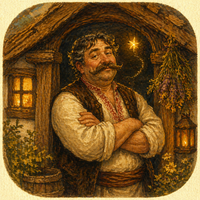
Let me tell you about one winter, the way an old chumak once told it to me. Only hear it out to the end. Because an unfinished story, they say, goes looking on its own for an ear to crawl into. And this one is about an inn at a crossroads, where the line between the living and those who have breathed their last is thinner than the ice on a puddle.
That inn stood far from the village, out among the bare fields. In winter, when the snow blew so thick you couldn't see the world, all manner of folk crowded in. And at that inn they had long known one simple thing: every guest brings with him the road he came by. A living man brought snow on his boots, frost on his moustache, and the smell of horse or smoke. But one who came not from the road brought something else. Not snow. Not cold.
But the smell of the place where the earth, the water or the darkness had once taken him. That night the blizzard howled like a mad thing. Everyone had fallen asleep where they lay: some on the bench, some on a sheepskin coat, some right by the stove. And somewhere around the third cockcrow there came a knock at the door. Not with a fist - with a palm, flat, quiet, as if someone were stroking the wood from the far side of the snow. The dog under the hearth didn't bark.
It only whimpered, hid its muzzle in its paws and fell still. The door opened by itself. On the threshold stood a pale woman in a thin shift. Barefoot, in the bitter frost. Her hair wet, matted, though outside the snow was dry and the wind was such that water in a bucket seized over with ice. She was not shivering. She only looked through the people and asked quietly whether a boy in a blue coat had come in here.
Her voice was like the crunch of ice underfoot. The innkeeper there, a man who had seen things, said at first that he'd seen no one of the kind. She nodded, but did not go. She stood by the stove, and the longer she looked into the fire, the quieter it crackled. The embers began to turn grey, the wood stopped snapping, as if the fire itself were afraid to remind her of warmth. The people sitting on the benches all around shrank into themselves.
And across the floor, from her bare feet, dark water came creeping. And it smelled not of snow but of rot and standing water from the pond behind the old dam. Everyone in those parts knew that pond. Once a boy had fallen through the ice there. He had been running the short way past the water, because the storm was already gathering strength. The body was never found. Only his coat was pulled out of the reeds.
The mother went then for three days from house to house, asking whether anyone had seen her little one. They told her the truth, but a mother's heart doesn't always take the truth the first time. On the fourth night she went to the pond alone. Without a cry. Without a candle. Only the tracks of bare feet were left in the snow.
The innkeeper did not look away this time, and did not hide behind a simple "no" again. To the one who has come out of the water, you must not lie. He said quietly: he never made it here. He stayed there, by the old dam, where the reeds hold the ice. And then the water on the floor stopped. Out of it rose such a sigh that every heart in the inn went cold for a moment.
The woman left without turning around, straight into the blizzard. The door closed without a sound. And on the threshold a puddle remained, and in it two wet footprints: a large one and a small one, a child's. Side by side. As if she had finally found the one she'd been calling. Those footprints did not dry until morning, though the wood was blazing in the stove again.
Since then, every winter, when the snow blows and the wind wails so the very windowpanes weep, at that inn they set a bowl of water and a heel of bread on the windowsill. By morning the bowl is always empty, and the bread is far too crumbly, as if it had been held on the bottom. And no one asks who came. Some guests come in only while the living sleep, and the old road remembers again those who never made it through.
Your verdict
Did you like this night tale?
Votes so far: 3
If the story touched you, the inn will be grateful.